Except otherwise indicated, the Seminar takes place on Wednesdays at 14:15 in Seminar Room A of the Mathematikon.
Schedule
05.11.2025
Speaker: Charles Daly (MPI-MIS, Leipzig).
Title: Deforming Geometric Structures in Low Dimensions.
Time: 14:15.
Abstract:
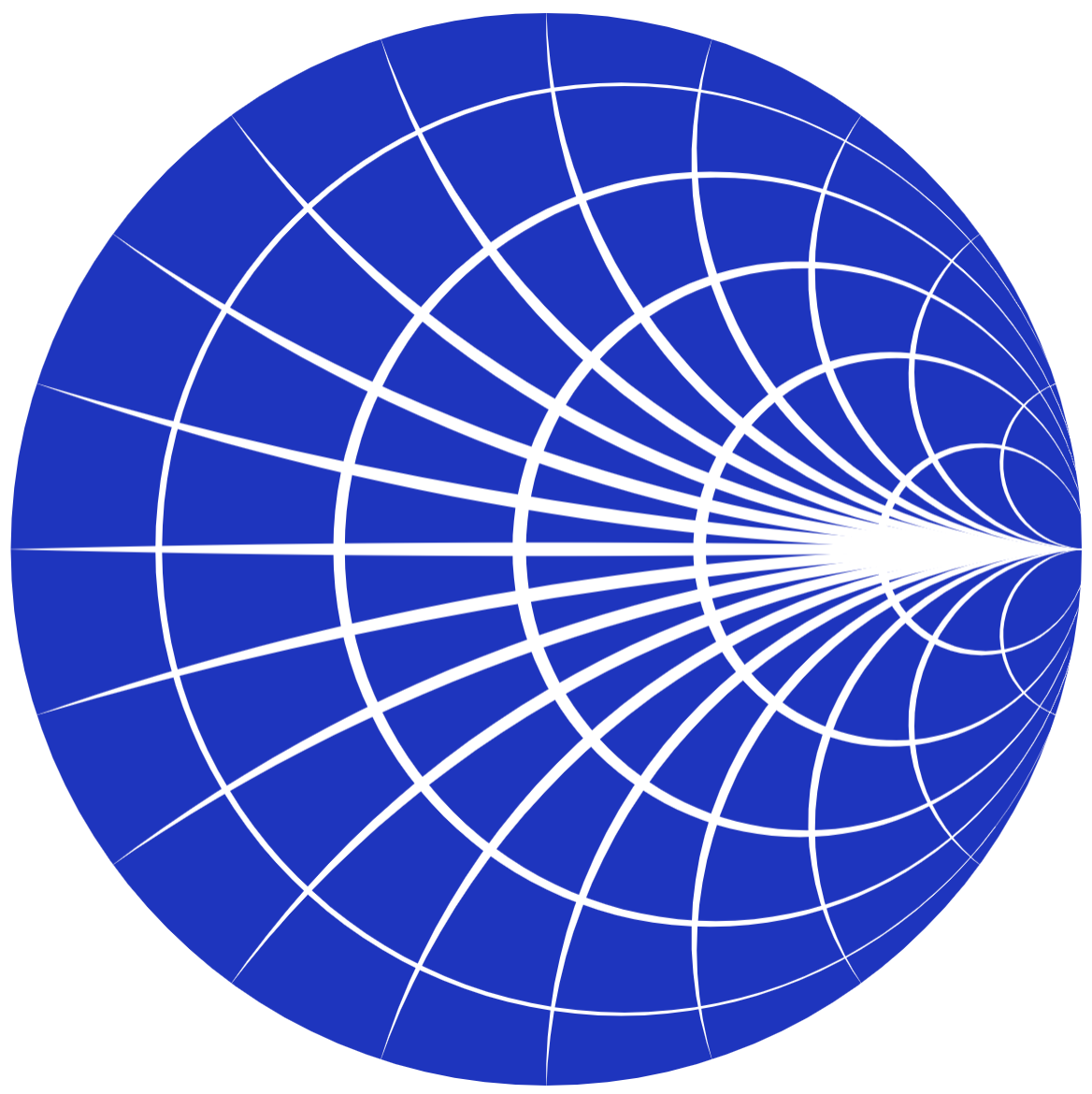
This talk will be an invitation to the study of geometric structures on manifolds through both example and illustration. We will review some fundamental results in the field regarding what types of geometric structures can exist in dimensions two and three, and how they can (or cannot) be deformed. Specifically, we aim to address fundamental questions about projective rigiditiy of hyperbolic 3-manifolds which we will motivate through computer illustration.
03.12.2025
Speaker: Matthew Litman (UC Dublin)
Title: Apollonian Circle Packings: Classical Constructions, Modern Perspectives.
Time: 14:15.
Abstract:
Given three pairwise tangent circles in the plane, Apollonius (~200 B.C.) asked the question of whether one could construct a fourth circle mutually tangent to the three starting circles. He showed not only that it was possible, but there are in fact two solutions (one contained in the region bounded by the three circles and one containing the three circles). If instead we started with four mutually tangent circles, Apollonius’ result tells us that there is a unique circle that can be inscribed in each region bounded by three of the circles. By continuing this circle-inscribing process ad infinitum, we arrive at an Apollonian Circle Packing (ACP).
In the 1640’s, through a very prolific exchange of ideas, Rene Descartes and Princess Elisabeth of Bohemia showed that the bends (1/radii) of four mutually tangent circles satisfy a quadratic equation, now known as Descartes’ equation. Some three hundred years later, Nobel laureate and chemist Fredrick Soddy rediscovered this quadratic relation and observed that if the bends of the four largest circles in a packing are all integers, then all the bends in a packing are integers! Around 70 years had past until the early 21st century when an investigation by Graham-Lagarias-Mallows-Wilks-Yan into the number theory of ACPs sparked two decades of fruitful exploration into the intricate relationships between the number theory, geometry, group theory, and combinatorics of ACPs. The renaissance sparked by their ideas has extended far beyond circle packings and influences many active areas of research today.
In this talk, we will discuss the classical constructions of Apollonian Circle Packings, the notion of Spherical and Hyperbolic Apollonian Circle Packings, the rich geometry connecting the three, and how this geometric picture can lead to arithmetic results. By passing back and fourth through different models of ACPs, number theoretic properties can be visualized and new approaches to problems (both old and new) reveal themselves.
This talk is partially based on ongoing work with Iván Rasskin (Aix Marseille University).
